I know these halls, Darklings. I know which portraits hang here, and which ones catch the candlelight first.
I did not move this one.
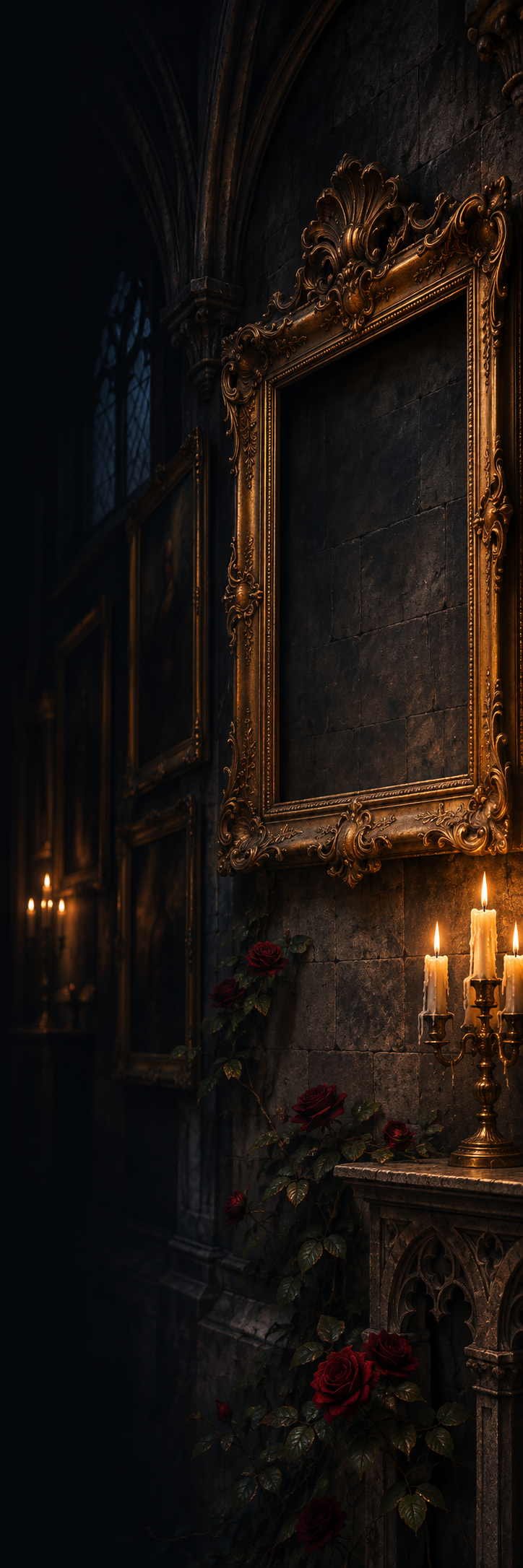
The frame is still on the wall. The portrait is gone.
I stood there trying to make that into something ordinary. Perhaps I’d taken it down and forgotten. Perhaps I was looking at the wrong place. From where I stood, I looked along the wall, checking the portraits on either side, then brought my gaze back to the empty frame.
No. This was where it belonged.
I would remember taking it out. Finding somewhere to put it. Coming back to this hall and seeing the space I’d left.
It’s a small thing to be certain of in your own house, isn’t it? That if you take a portrait off the wall, you’ll remember doing it.
I haven’t stepped closer yet.
From here, I can keep telling myself there’s something I haven’t noticed. A perfectly sensible explanation I’ll see as soon as I go over and look properly.
It would be easier to believe that if I could make myself go over.
I looked back the way I’d come. I could leave it until morning. Whatever had happened, it had already happened; I didn’t have to find out now.
But I stayed.
My feet stayed where they were, and the empty frame stayed where it was, and between us was all the hall I thought I knew.
I took one step, then paused.
I went closer.
Not because I’d stopped being afraid. I’d run out of explanations I could believe from the other end of the hall.
I kept my eyes on the empty frame as I approached. That was where the trouble was, surely. A portrait had gone missing. I needed to find out how.
Then one of the others looked at where it should have been.
I stopped.
There’s a difference between a painted face seeming to follow you and watching one look away. I tried to tell myself I’d only noticed the direction of its gaze because I was standing somewhere different.
I looked back at the frame, then at the portrait beside it.
Not at me. At the empty space.
The others were watching it too.
Now that I had a better look, I wanted the hall as it had been a moment ago, when there was only one thing wrong with it.
The portraits knew it was gone.
I looked from face to face. I wanted to ask what they knew, but I couldn’t quite bring myself to speak. What would I do if one of them answered?
They were waiting. That was how it looked from where I stood, anyway.
For it to come back?
Or for me to leave?
I’d thought the missing portrait was the thing I needed to fear. I hadn’t thought about the ones that stayed.
I left them watching the empty frame and went to look beyond the hall.
I searched the entire castle, room after room, for the portrait that had left its frame. I wanted to find it somewhere ordinary and feel foolish for having been afraid.
And then I found one.
But it was in a frame.
I’d never seen this portrait before. It had never hung on my wall. I looked at it, then looked again, trying to place it somewhere I knew.
I couldn’t.
I don’t hang unsigned portraits.
This one was unsigned.
Still, I found myself looking at it as though I were deciding where it might go. It was already framed. Ready to hang. I had to remind myself that I’d been searching for something missing, not choosing something new.
How did one portrait leave its frame, and I find another, framed and ready to go?
Finding this one ought to have given me something to work with. Instead, I had another portrait I couldn’t account for, and I was considering making room for it.
But the unsigned portrait wasn’t the one I’d been looking for.
I still wanted that one back.
So I kept looking. And I found her.
Elizabeth.
This portrait I knew. The signed one, removed from its frame. For a moment, knowing her was enough. I’d been searching for something familiar, and here she was.
Then I looked again at where I’d found her.
Of all the places in the castle, I hadn’t expected her there. I wanted to be pleased, to have nothing more to think about than Elizabeth being back home. Instead, I kept trying to account for where she’d been.
Who put you there, Elizabeth?
Or were you hiding?
It was easier to be glad she was back before I started asking that.
I looked at the portrait again. Familiar. Signed. The one I’d been missing. I wanted those things to be enough to settle me, but I still couldn’t make sense of the place where I’d found her.
Elizabeth’s portrait was folded under the dresser.
I wanted her back in her frame, but finding her hadn’t put her right.
So I called a friend with special skills.
He came for her that day. He didn’t just take Elizabeth. He gave me a warning, and a very specific name. Both for the other portrait.
Trouble.
Dorian.
I’d called him about Elizabeth. Now I had a name for the unsigned portrait, and I wanted to know why he’d said it like that.
The person who came to collect a portrait for restoration recognized him immediately. They stopped in front of him, looked at me, and asked where I had found him.
Propped against a wall. Fully framed. Unsigned.
That did very little to improve their expression.
“That’s Dorian. He’s trouble.”
Well. We do have rather a lot of that here. I asked them to be more specific.
Apparently, there are stories about him in houses that haven’t stood for centuries. The details change with the telling, but there is always a handsome stranger who arrives unexpectedly and is made very welcome.
Someone gives him a room. Someone sets a place for him at supper. Everyone assumes someone else invited him.
And by the time anyone thinks to ask, there is someone in the house who cannot bear the thought of him leaving.
“What happens to that person?” I asked.
My visitor spent rather a long time securing the portrait they had come to collect.
“In the story I heard, they went with him.”
“Willingly?”
They looked back at Dorian.
“That depends on who is telling it.”
Then they left me with my unsigned portrait and considerably more questions than I had before.
I haven’t hung him. I still don’t know who painted him, or who thought he belonged here.
But I did pull up a chair.